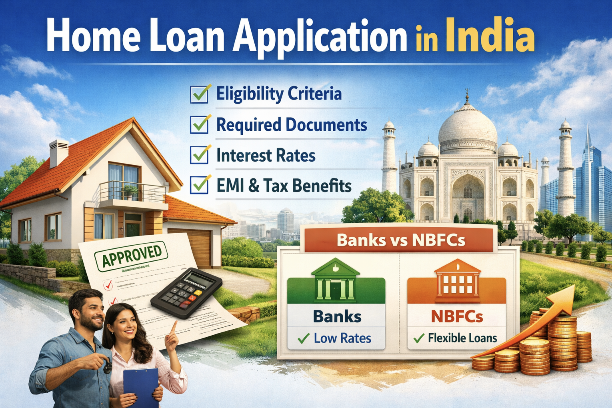
Complete guide on Home Loan Application in India. Learn eligibility, documents, interest rates, bank-wise comparison, EMI tips & expert insights.
Complete Guide on Home Loan Application in India (2025 Edition)
Eligibility, Documents, Interest Rates, Banks vs NBFCs, EMI Planning & Expert Tips
Buying a home is one of the most important financial decisions in an Indian household. For over 80% of Indian homebuyers, a home loan is not just a financial product—it is a long-term commitment that shapes savings, lifestyle, and future security.
With changing RBI policies, repo rate fluctuations, rising property prices, and evolving lender criteria, applying for a home loan in India has become both an opportunity and a challenge.
This complete guide on home loan application in India is designed as a one-stop knowledge resource for salaried professionals, self-employed individuals, first-time buyers, and investors. It explains how home loans work, who is eligible, what documents are required, interest rate comparisons, lender-wise insights, real-life examples, and expert strategies to get the best deal.
1. What Is a Home Loan?
A home loan is a secured loan provided by banks or NBFCs to purchase, construct, renovate, or extend a residential property. The property itself acts as collateral, which is why home loans usually have lower interest rates compared to personal or business loans.
Common Uses of Home Loans in India
- Purchase of ready-to-move flats or houses
- Purchase of under-construction property
- Construction of an independent house
- Home extension or renovation
- Balance transfer from one lender to another
2. Types of Home Loans in India
Understanding the type of home loan helps you choose the right product.
2.1 Home Purchase Loan
For buying a new or resale residential property.
2.2 Home Construction Loan
For constructing a house on a self-owned plot.
2.3 Home Improvement / Renovation Loan
For repairs, interiors, modular kitchen, plumbing, flooring, etc.
2.4 Plot Loan
For purchasing a residential plot (construction usually mandatory within a few years).
2.5 Home Loan Balance Transfer
To shift your existing loan to another lender at a lower interest rate.
2.6 Top-Up Home Loan
An additional loan over your existing home loan, usually at a lower rate than personal loans.
3. Home Loan Eligibility Criteria in India
Eligibility differs slightly across lenders, but core parameters remain the same.
3.1 Age Criteria
- Minimum: 21 years
- Maximum at loan maturity:
- Salaried: 60–65 years
- Self-employed: 65–70 years
3.2 Income Eligibility
Salaried Applicants
- Minimum monthly income: ₹20,000–₹25,000 (varies by city)
- Stable job with at least 1–2 years of work experience
Self-Employed Applicants
- Minimum business vintage: 2–3 years
- Stable and verifiable income through ITRs and bank statements
3.3 Employment Type
- Salaried (private, government, PSU)
- Self-employed professional (CA, doctor, architect)
- Self-employed non-professional (business owner)
3.4 Credit Score (CIBIL Score)
- 750+: Excellent (best interest rates)
- 700–749: Good (approval likely)
- 650–699: Moderate (higher rate or lower amount)
- Below 650: Difficult approval
4. Documents Required for Home Loan Application
4.1 Identity Proof
- Aadhaar Card
- PAN Card
- Passport / Voter ID / Driving Licence
4.2 Address Proof
- Aadhaar
- Utility bills
- Passport
4.3 Income Documents (Salaried)
- Last 3–6 months salary slips
- Form 16
- Last 6 months bank statements
- Employment confirmation letter (if required)
4.4 Income Documents (Self-Employed)
- ITRs for last 2–3 years
- Balance sheet & P&L
- Business registration proof
- GST returns (if applicable)
4.5 Property Documents
- Sale agreement
- Title deed
- Approved building plan
- Occupancy / Completion certificate
- Encumbrance certificate
5. Home Loan Interest Rates in India (2025)
Home loan interest rates are mostly repo-linked and fluctuate with RBI policy.
Current Interest Rate Range
- Banks: 8.35% – 9.75% p.a.
- NBFCs: 9.00% – 11.50% p.a.
Fixed vs Floating Interest Rate
| Feature | Fixed Rate | Floating Rate |
|---|---|---|
| Stability | Fixed EMI | EMI changes |
| Initial Rate | Higher | Lower |
| Long-term Cost | Higher | Usually cheaper |
| Best For | Short tenure | Long tenure |
6. Top Home Loan Providers in India (Lender-Wise Analysis)
6.1 State Bank of India (SBI)
Interest Rate: 8.40% onwards
Loan Amount: Up to ₹10+ crore
Pros
- Lowest interest rates
- High trust factor
- No prepayment charges
Cons
- Slower processing
- Strict documentation
Best For: Long-term buyers, government employees
6.2 HDFC Ltd
Interest Rate: 8.50% onwards
Pros
- Fast approval
- Flexible eligibility
- Excellent customer support
Cons
- Slightly higher rates than PSU banks
Best For: Salaried professionals, premium borrowers
6.3 ICICI Bank
Interest Rate: 8.60% onwards
Pros
- Fully digital process
- Quick disbursal
Cons
- Processing fees can be high
Best For: Urban salaried customers
6.4 Axis Bank
Interest Rate: 8.75% onwards
Pros
- Customized loan structures
- Good balance transfer offers
Cons
- Rate negotiation required
6.5 LIC Housing Finance
Interest Rate: 8.45% onwards
Pros
- Long tenure options
- Trust and stability
Cons
- Documentation heavy
6.6 Bajaj Finserv (NBFC)
Interest Rate: 9.25% onwards
Pros
- Flexible income norms
- Fast disbursal
Cons
- Higher interest than banks
Best For: Self-employed applicants
7. EMI Calculation & Loan Planning (Real Example)
Example
- Loan Amount: ₹50,00,000
- Interest Rate: 8.6%
- Tenure: 20 years
EMI ≈ ₹44,000
Total Interest Paid ≈ ₹55 lakh
👉 Expert Tip: Increasing EMI by just ₹5,000/month can reduce tenure by 6–7 years.
8. Home Loan Tax Benefits in India
Section 80C
- Principal repayment up to ₹1.5 lakh
Section 24(b)
- Interest deduction up to ₹2 lakh
Section 80EE / 80EEA
- Additional benefits for first-time buyers
9. Common Mistakes to Avoid While Applying for Home Loan
- Applying with low credit score
- Over-stretching EMI beyond 40–45% of income
- Ignoring processing fees & hidden charges
- Choosing wrong tenure
- Not comparing lenders
10. Expert Tips to Get Home Loan at Lowest Interest Rate
- Maintain CIBIL score above 750
- Choose joint applicants
- Opt for repo-linked loans
- Negotiate processing fees
- Compare before applying
11. Banks vs NBFCs – Which Is Better?
| Factor | Banks | NBFCs |
|---|---|---|
| Interest Rate | Lower | Higher |
| Approval | Strict | Flexible |
| Speed | Moderate | Fast |
| Best For | Salaried | Self-employed |
12. Future of Home Loans in India (2025–2030)
- More digital approvals
- AI-based credit scoring
- Flexible EMI products
- Green home loan discounts
13. FAQs on Home Loan in India
Q. Can I get 90% home loan?
Yes, for properties under ₹30 lakh (subject to RBI norms).
Q. Is prepayment allowed?
Yes, floating-rate home loans have zero prepayment charges.
Q. Can self-employed get home loan easily?
Yes, with proper ITRs and bank statements.
Conclusion: How to Choose the Right Home Loan in India
A home loan is not just about interest rate—it’s about long-term affordability, flexibility, tax efficiency, and peace of mind. The best home loan is one that aligns with your income stability, future goals, and risk appetite.
Before applying: ✔ Compare lenders
✔ Improve credit score
✔ Understand EMI impact
✔ Read the fine print
A well-planned home loan can help you build wealth, not stress.
Relevant Keywords:
Home Loan
Follow Us on Social Media